If you're here, chances are you've already started questioning the way we've been taught to eat. Maybe you're tired of chasing the next supplement, cutting out another food, or wondering whether breakfast should be high protein, low carb, plant based, intermittent, raw, or something else entirely. There is more nutrition information available to us than ever before, yet somehow eating well has never felt more complicated.
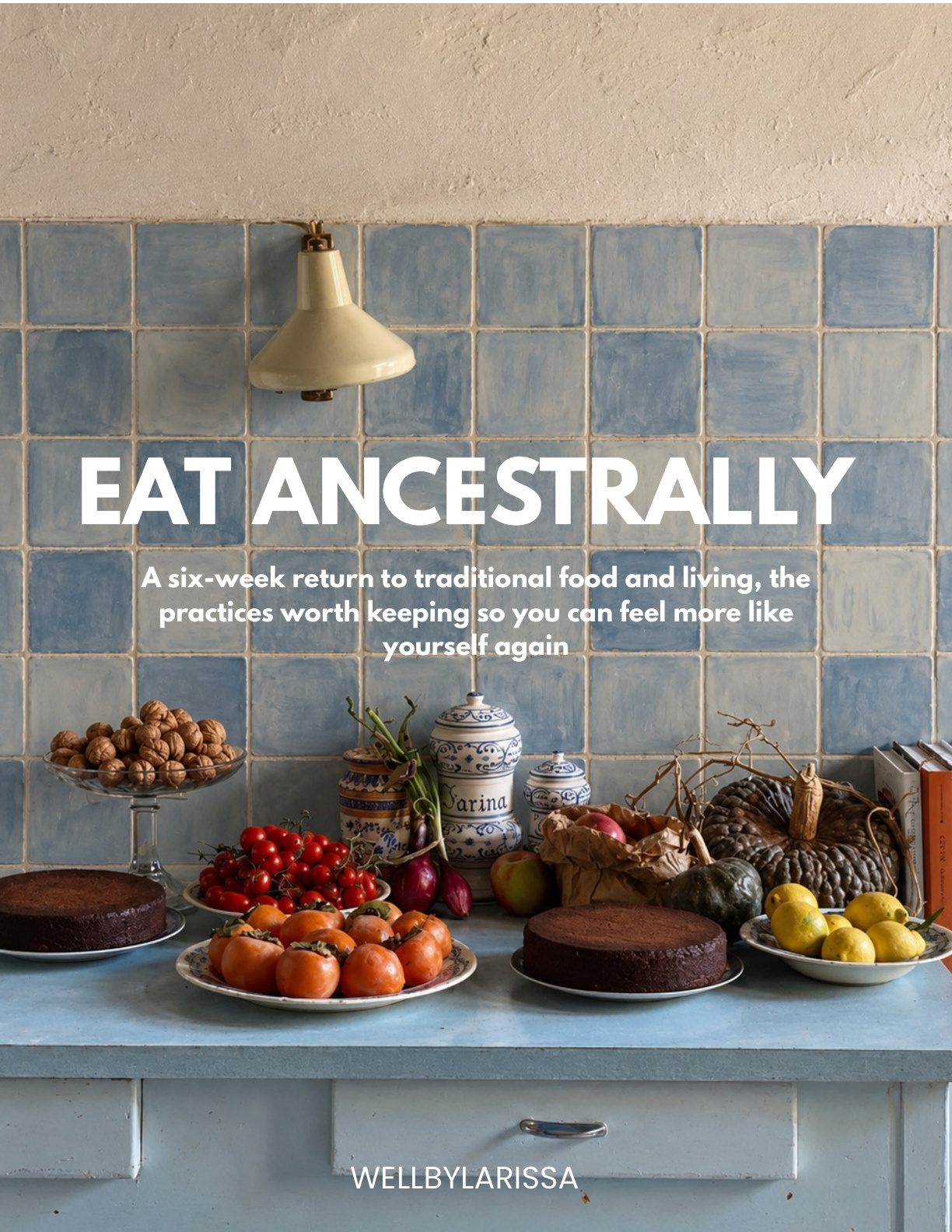
Eat Ancestrally was created to bring you back to something simpler. Before food came with ingredient lists, wellness trends, and rules that changed every few months, people learned how to nourish themselves through generations of cooking, preserving, fermenting, eating with the seasons, and making use of the foods available around them. This course is about taking that wisdom and making it practical for the way we live now.
Over six weeks, we'll move through the foundations of ancestral eating, warm and traditionally prepared foods, nourishment for the female body, the ancestral kitchen, the daily rhythms that support us beyond the plate, and finally, how to take everything you've learned into restaurants, travel, family meals, and real life. You'll learn the why, but more importantly, you'll learn what it actually looks like in your kitchen.
By the end, I don't want you following another diet. I want you standing in your kitchen making a warm breakfast without thinking twice about it. Knowing how to build a nourishing meal from what you have. Understanding how your needs may shift throughout your cycle and the seasons. Knowing which traditions are worth bringing back and which ones simply don't work for you.
Most of all, I want you to feel less overwhelmed by food and more confident feeding yourself. This isn't about going backward. It's about bringing the wisdom that still serves us forward.
2. Sit down for at least one meal without rushing
3. Notice your hunger and energy between meals
Before we talk about what to eat, we need to talk about how complicated eating has become. We have more nutrition information available to us than any generation before us, yet so many women feel completely overwhelmed by food. We're told to fast, then eat breakfast. Avoid carbohydrates, then eat more of them. Eat raw vegetables, prioritize protein, track glucose, count macros, take supplements, remove another food.
This course is an invitation to step outside of that noise for a little while. Instead, we're going to look at the food traditions that existed long before nutrition became an industry and ask a much simpler question: what practices are still worth bringing into our kitchens today? Not because everything old was better, not because there was one perfect ancestral diet, and certainly not because we're trying to recreate life hundreds of years ago. We're looking for the threads that appear again and again across traditional food cultures and learning how to make them practical for modern life.
The Traditional Chinese Medicine digestion clock
Traditional Chinese Medicine describes a 24 hour cycle in which different organ systems are considered most active at different times, and three of these windows map directly onto practical eating guidance.
Taken together, this is the traditional logic behind a simple pattern worth trying this week: a real breakfast, your biggest meal at lunch when digestion is at its strongest, and a lighter dinner with some space before bed. This is a traditional framework rather than a biomedical model, but the practical guidance it produces, discussed in more depth next week, has held up remarkably well against what modern chronobiology has independently found about the body's digestive rhythm across the day.
Why this matters: these three patterns are the foundation the rest of this course builds on, everything from here forward is really just one of these three ideas applied to a specific food or practice.
Warm and cooked food. Across many traditional food cultures, cooked foods played an important role in everyday eating. Porridges simmered over fire, eggs cooked in fat, broths and soups, stewed fruit, rice, grains, roots, meat and vegetables transformed through heat. This doesn't mean cold food is inherently bad or that you should never have another smoothie. It simply means we're going to experiment with bringing more warmth and cooking back into a meal that has become increasingly cold, rushed and convenient in modern life: breakfast.
Seasonal and local eating. For most of human history, people ate according to what was available in their climate, season and geography. Food changed throughout the year because availability changed. Fresh foods were eaten when abundant, others were dried, fermented, salted, cured, stored or preserved for the months ahead. Today, a supermarket can make July and January look remarkably similar. Throughout this course, we'll explore what it can look like to bring some of that natural variation back.
Using more of what we have. Traditional kitchens were often incredibly resourceful. Bones became broth, fat was rendered for cooking, tough cuts were slowly simmered, organs were eaten, vegetables were fermented, scraps found their way into soups and stocks. Not every culture practiced these traditions the same way, but the underlying principle is one to carry throughout this course: nourishment doesn't have to be complicated, but it does ask us to become more connected to our food.
Why this matters: getting this definition right up front keeps you from either dismissing this course as impractical nostalgia, or trying to follow it too rigidly. Neither extreme is the goal.
The word ancestral gets used loosely, so it's worth being clear about what it means here. It doesn't mean primitive. It doesn't mean rejecting modern medicine or science. And it doesn't mean copying exactly what one particular culture ate hundreds of years ago. There has never been one universal ancestral diet, people ate differently depending on geography, climate, culture, religion, agriculture and availability.
What matters are the practices that appear repeatedly across traditional food cultures: cooking from basic ingredients, preserving and fermenting food, eating seasonally, using more of the animal and plant, sharing meals, and passing food knowledge from one generation to another. Your job isn't to reenact the past. It's to notice which pieces of traditional wisdom still serve you and bring them forward into your modern kitchen.
Why this matters: understanding how recently our food environment changed helps explain why symptoms that feel personal are actually incredibly common. This isn't a personal failing, it's a mismatch between your body and a food system that's only about a century old.
The way most of us eat today would be almost unrecognizable to someone living only a few generations ago. Industrial processing changed how food was produced and preserved. Refrigeration changed seasonality. Global transportation changed what was available locally. Convenience foods changed how much cooking happened at home.
Some of those changes made life enormously easier. Others meant that foods and preparation methods that once appeared regularly in kitchens became far less common. Rather than labeling everything modern as bad and everything traditional as good, we're going to look at what disappeared and decide what might be worth bringing back.
Why this matters: these five things show up again and again in the weeks ahead. Knowing why they matter now will make every later lesson click faster.
Traditional cooking fats. Butter, ghee, tallow, olive oil and other traditional fats have been used in food cultures around the world. Dietary fat also helps us absorb the fat soluble vitamins A, D, E and K and contributes essential fatty acids and energy. Throughout this course, you'll learn how to choose cooking fats based on the food you're making, the cooking method, and the tradition you're drawing from.
Organ meats. Organ meats are exceptionally nutrient dense foods. Depending on the organ, they can provide concentrated amounts of nutrients such as vitamin A, vitamin B12, iron, copper, folate and choline. You do not need to start eating liver every morning. We'll explore simple ways to incorporate organ meats if you choose to, and there will always be other options if they're not for you.
Fermented foods. Fermentation developed independently in food cultures around the world as a way of transforming and preserving food. Sauerkraut, kimchi, yogurt, kefir, miso, sourdough and countless other fermented foods came from different places but share the same idea, allowing microorganisms to transform food. We'll explore how fermentation works and how to incorporate fermented foods safely and practically.
Broth and stock. Broths and stocks are one of the simplest examples of traditional kitchen resourcefulness. Bones, connective tissue, vegetables, herbs and scraps that might otherwise have been discarded could become the foundation of another meal. Depending on how they're prepared, broths can provide gelatin, amino acids and other nutrients while adding warmth, flavor and richness to everything cooked with them.
Seasonal variety. Modern grocery stores allow us to eat almost the exact same foods twelve months a year. Seasonal eating invites a little variation back onto the plate. That doesn't mean you need to grow your own food or eat exclusively from a farmers market, it simply means becoming aware of what grows around you and allowing your meals to shift with the year when practical.
Why this matters: if you only ever focus on food and ignore everything else, you'll hit a ceiling on how much better you can feel. This section explains why, alongside why subtraction usually isn't the best place to start.
Food doesn't exist in isolation. Digestion interacts with your nervous system, sleep, stress, movement, hormones, medications, health conditions and countless other parts of your life. That is why this course will never ask you to believe that one breakfast, ingredient or food tradition is going to solve everything. Instead, we're building a foundation, asking whether meals can become warmer, more nourishing, less rushed and more intentional, and then paying attention to how you respond.
Many modern approaches to digestive symptoms begin with subtraction. Remove gluten, remove dairy, remove sugar, remove FODMAPs, remove whatever food is currently being blamed online. Elimination diets can have legitimate clinical uses and can sometimes help identify individual triggers, but restriction isn't the only tool available to us. Throughout this course, we'll also ask what may be worth adding back: warm meals, satisfying fats, protein, mineral rich foods, traditionally prepared foods, fermented foods where tolerated, seasonal variety. Instead of beginning with "what else should I stop eating," this course wants you to start asking "what might my meals be missing."
Why this matters: overwhelm is the number one reason people quit a new way of eating in the first week. This section exists purely to protect you from that.
Right here. Warm breakfast, seven mornings. That's enough. You don't need to buy liver, ferment cabbage, make bone broth and reorganize your pantry before Wednesday. The depth in this course is here so you understand what you're doing, not because you're expected to implement everything immediately. Learn deeply, change slowly.
Why this matters: you can eat a perfect diet and still digest poorly if your nervous system never gets the signal that it's safe to do so. This is often the missing piece.
Stress and digestion are closely connected through the nervous system. When you're constantly rushing, working, scrolling or eating while doing three other things, it can also become incredibly difficult to notice your own hunger, fullness and response to food. So alongside your warm breakfast, experiment with something else: sit down, even if it's only for ten minutes. Put the food on a real plate or in a real bowl. Take a few breaths. Eat without trying to accomplish something else at the same time when you can. The way we eat matters too.
Why this matters: if sleep is genuinely your bottleneck right now, no food change in this entire course will outperform fixing that first.
You can eat beautifully and still feel terrible when you're chronically underslept. Sleep influences appetite regulation, glucose metabolism, mood, energy and countless other processes that affect how we experience food and hunger. So if you're sleeping five broken hours every night, the answer isn't necessarily another dietary restriction. Sometimes the highest leverage nutrition decision has nothing to do with what's on your plate. This course focuses on food, but food is only one part of how you nourish yourself.
Why this matters: this is the skill that makes every other week of this course actually work. Without it, you're just following instructions instead of learning your own patterns.
If you're used to grazing throughout the day, this week is also an opportunity to simply notice it. You don't need to force yourself into a rigid eating schedule. Instead, experiment with eating satisfying, defined meals and giving yourself enough space afterward to notice what happens. Are you actually hungry an hour later? Did breakfast keep you satisfied? Do you feel energized, heavy, comfortable, bloated? There is no correct answer. You're beginning to collect information about your body, rather than following someone else's rules.
Why this matters: this is the bridge into next week's deeper dive on meal timing. Pay attention here and next week's lesson will feel obvious rather than new.
Many traditional food cultures placed substantial importance on the midday meal, and modern research into circadian biology has also made the timing of food an interesting area of study. But this isn't meant to become another rigid rule. You don't need to force yourself to eat an enormous lunch or a tiny dinner because this course told you to. Instead, notice: which meal is currently your biggest? When do you naturally feel hungriest? How do you feel after a very heavy late dinner compared with an earlier substantial meal? This week is about awareness. We'll explore meal timing more deeply next week.
Why this matters: modern nutrition tends to ask what's in a food, protein, calories, fiber, vitamins. Traditional food cultures asked a second question just as often: how is this food prepared, eaten, and tolerated. That second question is one you'll keep returning to throughout this course.
Ayurveda and Traditional Chinese Medicine both placed digestion at the center of health, agni and the Spleen and Stomach respectively, frameworks you'll go deeper on next week. But you don't have to look only to formal medical systems to see this pattern. Look at traditional kitchens around the world and certain practices appear again and again: broths simmered for hours, ginger used throughout Asian cooking and herbalism, digestive herbs like fennel, mint, anise and caraway showing up independently across India, Europe and the Mediterranean, vegetables and dairy fermented, grains and legumes soaked or slowly cooked. The explanations differed by culture, but the underlying instinct was shared, supporting digestion through how food was prepared and eaten, not through a supplement aisle.
A few small traditions worth trying this week, pick one rather than all of them:
Herbs don't only belong in capsules, they can simply be dinner: cumin and coriander toasted in ghee, fresh ginger in a soup, cardamom simmered with warm milk. And preparation itself does real work too, grains soaked, vegetables simmered or fermented, tough cuts cooked low and slow for hours. Sometimes you don't need to change the food, just the way you prepare it.
Choose one practice this week and pay attention rather than adding all of them at once. How does your stomach feel after eating? Comfortably satisfied, or overly full? Any bloating, belching, or heaviness? How does a warm, cooked meal compare to a cold one, or eating seated compare to eating rushed? There isn't one correct digestive ritual. The point is simply to begin paying attention again.
The two accordions above already touched on Ayurveda's agni and TCM's Spleen and Stomach. Here are two lesser known concepts from those same traditions, each with real specificity most ancestral health content never gets into. TCM and Ayurveda are distinct systems with their own theories and language, they aren't presented here as saying the same thing, just as two independent traditions that both took digestion seriously.
Classical Chinese medicine describes two sources of vital energy, or Qi. Pre-Heaven Qi is the constitutional reserve you're born with, inherited and finite. Post-Heaven Qi is generated daily, primarily through digestion, from the food and air you take in. The Spleen and Stomach's traditional job is transforming food into this daily Qi.
This framework gave digestion genuine weight in classical thought, poor digestion over time was traditionally understood to mean the body draws more heavily on its finite Pre-Heaven reserve rather than replenishing daily from Post-Heaven Qi, which was considered a slow, cumulative drain worth avoiding through consistent eating habits.
This is the traditional reasoning underneath something you're already doing this week, a warm, regular breakfast isn't just pleasant, in this framework it's daily maintenance, generating what your body needs today rather than borrowing from a reserve you can't easily replace.
Ayurveda doesn't describe agni, digestive fire, as one fixed thing. Classical texts traditionally describe four states: Sama Agni, balanced digestion, considered the healthy baseline. Vishama Agni, irregular, unpredictable digestion. Tikshna Agni, sharp and intense, traditionally associated with a tendency toward acidity. Manda Agni, slow and sluggish digestion.
Each state traditionally suggested a different approach, irregular digestion called for consistent meal timing above all else, sharp or acidic tendencies called for cooling, less spiced food eaten calmly, and sluggish digestion called for lighter meals, warming spices, and smaller portions eaten more slowly. This wasn't a label to adopt permanently, digestion was understood to shift with season, stress, and age.
Notice which pattern your own digestion has leaned toward this week, irregular, sharp, or slow, without needing to label yourself permanently, and let that observation point you toward regularity, calm and cooling, or lightness and warmth, whichever actually matches what you noticed.
- 2 to 3 eggs
- 1 tbsp butter
- Fresh chives or dill, chopped
- Salt and pepper
- Melt butter in a pan over low heat
- Add eggs, stir slowly and constantly
- Remove from heat just before fully set
- Fold in herbs, salt, and pepper, serve warm
- 1/2 cup rice, rinsed
- 4 cups bone broth or water
- 1 inch ginger, sliced
- Soft egg and scallion to top
- Combine rice, broth, and ginger in a pot
- Simmer uncovered 40 to 50 min, stirring occasionally
- Add water if it thickens too much
- Top with a soft egg and scallion, serve hot
- You understand why modern nutrition advice can feel so contradictory and overwhelming.
- You know the three patterns, warmth, seasonality, resourcefulness, that show up across nearly every traditional food culture.
- You understand what "ancestral" actually means, and what it doesn't.
- You know why starting with addition tends to work better than starting with elimination.
- You understand how stress and sleep affect digestion just as much as food does.
- You can build a warm, satisfying breakfast without a recipe.
2. Make one real soup and one porridge this week
3. Notice how warm, moist food feels compared to your usual meals
Maybe you noticed something last week. Maybe breakfast kept you satisfied longer. Maybe you enjoyed starting your morning with something warm. Maybe your digestion felt different. Or maybe you didn't notice much at all. That's useful information too.
This course isn't about convincing yourself that you're feeling something because I told you that you should. It's about becoming observant again. This week we take warmth, one of the principles running through traditional food cultures, and expand it across the whole day.
Soup, a food tradition older than nutrition science
Soup shows up as a near universal practice across traditional cultures, not as a starter or an afterthought, but as a primary way of eating. The logic repeats everywhere: water, inexpensive ingredients, and time turn into a real meal. Soup stretched meat further, used bones and scraps that would otherwise go to waste, made use of whatever vegetables were in season, and let grains, legumes, herbs, and animal foods become one dish instead of three separate components on a plate.
Many traditional systems have a concept for what we might call digestive warmth or digestive capacity. Ayurveda calls it agni. Traditional Chinese Medicine has its own concepts around the Stomach and Spleen and the warmth digestion depends on. These are traditional frameworks, not biomedical diagnoses, and they're worth understanding on those terms rather than as clinical fact.
What these traditions agree on is that warmth mattered. Soups, porridges, stews, ginger, and warming spices show up again and again, especially when digestion felt weak or unsettled. I don't want you to accept that simply because Ayurveda or TCM says so. I want you to experience the practice and decide how your body responds.
Traditional systems have taken warmth seriously in digestion for thousands of years, and that consistency across cultures who never spoke to each other is worth trusting on its own terms, not treated as something that needs a lab result to justify it. What we do know from modern science lines up well with that tradition, even if it doesn't map onto it point for point. Your digestive tract maintains a tightly regulated internal environment, cold food is warmed once you eat it, and cooking itself physically transforms food, softening plant fibers, gelatinizing starches, changing texture in ways raw food simply isn't. Simmering, steaming, stewing, roasting, and braising are foundational techniques across nearly every traditional cuisine, not incidental ones, and countless people find cooked food genuinely easier and more comfortable to eat. That pattern, arrived at independently by cultures with no contact with each other, is worth taking seriously.
Try to move away from making raw, cold food the foundation of your diet this week, and here's the actual reasoning behind that, not just a preference. Before mechanical refrigeration existed, truly cold food barely existed as a category at all, meals were eaten close to the temperature they were cooked at, or gently reheated. Traditional Chinese Medicine, Ayurveda, and European folk medicine all independently developed a wariness toward cold, raw food, especially first thing in the morning or during recovery from illness, childbirth, or menstruation, not from a controlled study, but from generations of women watching what actually helped the women around them.
That doesn't mean you need to fear a piece of fruit, a summer salad, or the occasional cold meal. It means shifting the default. Instead of automatically assuming raw is more nutritious, a smoothie is healthier than breakfast, or a giant cold salad is the ideal lunch, we're bringing cooking back. The goal isn't fear of cold food. It's a return to cooked food as the foundation.
Metabolism follows circadian rhythms, and research suggests that glucose tolerance and insulin sensitivity can vary across the day for many people, often trending higher earlier in the day. This doesn't prove the TCM organ clock, and it isn't a universal rule that everyone's largest meal must fall before a specific hour. It's simply a reason to stay curious about when you eat, in addition to what you eat, and to notice how the timing of your own meals actually affects you.
These aren't "good food/bad food" swaps. We're changing the variable for one week so you can notice the difference.
A lot of the modern American plate is built around dry heat, roasted, baked, grilled, fried, air fried. Traditional cooking around the world leaned heavily the other way, toward moist heat, water doing as much of the work as the fire underneath it. Simmering, stewing, braising, poaching, steaming, and slow porridge making all share the same underlying idea, food transformed gradually by heat and liquid together, rather than seared quickly and left to fend for itself.
Moist cooking changes food in ways dry heat doesn't. It softens tough plant fibers. It gelatinizes starches, which is why a long simmered grain turns creamy instead of staying separate and dry. It slowly breaks down the connective tissue in tougher, more affordable cuts of meat until they turn tender rather than chewy. And it produces broths and sauces that become part of the meal itself, not a byproduct thrown away.
This week, alongside your warm food experiment, make one real soup and one porridge or congee, something simmered slowly rather than quickly assembled. Notice how different it feels to eat compared to a dry, roasted plate.
Cooking physically transforms food. Heat softens plant fibers, gelatinizes starches, and changes texture and structure in ways that raw preparation doesn't. That transformation is part of why cooked foods sit at the center of Ayurveda, Traditional Chinese Medicine, and traditional food cultures around the world, not as an aesthetic preference but as a deliberate practice repeated across generations. The goal isn't fear of cold food. It's a return to cooked food as the foundation, and this week is your chance to actually notice what that shift feels like in your own body rather than taking anyone else's word for it.
This is not about fear or perfection. A cold snack here and there is not going to undo your progress, and there is no need to panic over an occasional cold meal when warm is not available. The goal this week is shifting your default, what you reach for automatically, not achieving a flawless record. Someone with strong, resilient digestion may tolerate cold food with little issue. Someone rebuilding digestive strength benefits from leaning warm more consistently while that rebuilding happens. Let how your body actually responds be the guide, not a rule applied without exception.
Traditional Chinese Medicine's concept of the stomach fire is described as having its own rhythm and its own vulnerabilities, and traditional practice treats supporting it as central to nearly every aspect of health, not just digestion. A weak stomach fire was traditionally associated with sluggishness, poor absorption, and a buildup of what TCM calls dampness, loosely translated as a heavy, stagnant residue from food the body could not fully process. A strong, balanced stomach fire was associated with clear skin, stable energy, and resilience. This is a traditional framework, not a biomedical diagnosis, and it should be understood on those terms. Whether you understand this through a TCM lens or simply as a traditional practice, the experiment remains the same: bring more warmth and rhythm to your meals and observe your own response.
Food temperature is not a treatment for a digestive disorder, and it's worth being direct about that. If you've been experimenting with warm, well timed meals and your digestion still feels significantly off, persistent reflux, ongoing severe bloating, pain, or other symptoms that don't budge, that's worth bringing to a doctor rather than assuming you're simply not doing the food changes correctly. This course gives you a strong foundation. It is not a substitute for care when your gut is telling you something more specific is going on.
The accordions above already touched on TCM's stomach fire and the case for warmth over cold. Here are two more specific concepts from those same traditions, on hydration and on why the same meal can affect two people so differently. TCM and Ayurveda are treated separately here, distinct systems with distinct theories, not one blended tradition.
Classical Chinese medicine never treated hydration as a single, uniform thing to maximize. It describes two broad categories of body fluid, Jin, thinner, more mobile fluids like sweat and saliva that moisten the skin and surface tissues, and Ye, thicker, denser fluids associated with joints, the brain, and deeper tissues. Both were understood to come from the food and drink you take in, transformed and distributed by the same digestive system discussed earlier this week.
Because fluid had to be generated and distributed by digestion rather than simply consumed, this framework never encouraged drinking large volumes of plain water regardless of need. Soups, congee, cooked fruit, and warm teas were traditionally considered better sources of usable fluid than iced water in large quantities, since they were seen as easier for the digestive system to actually convert into Jin and Ye rather than passing through as a burden.
This is the traditional case for something already built into this week, treating soup, broth, and warm tea as real hydration, not just water's afterthought. Notice whether a warm mug or a bowl of soup satisfies your thirst differently than a large glass of cold water.
Ayurveda traditionally describes three broad tendencies, or doshas, that shape how a person's digestion behaves. Vata-leaning digestion tends toward irregularity and gas. Pitta-leaning digestion tends to be strong, fast, and prone to acidity or heat. Kapha-leaning digestion tends to be slow, steady, and heavier. These were never meant as fixed personality types, but as one lens for why the exact same bowl of cold cereal might unsettle one person and barely register for another.
Traditional guidance followed the tendency rather than a universal rule, warm, grounding, regular meals for Vata-leaning digestion, cooling and moderate portions for Pitta-leaning digestion, and lighter, warmly spiced meals for Kapha-leaning digestion. The point was never to self-assign a permanent label, but to notice which tendency your own digestion has leaned toward and let that guide small adjustments.
If cold, raw food has genuinely never bothered you, that's useful information about your own digestion, not a sign this week doesn't apply. If it does unsettle you, warmth and regularity are exactly what traditional guidance would suggest leaning into further.
- 1 lb bone-in chicken thighs or a small whole chicken, cut up
- 8 to 10 dried red dates (jujubes), pitted
- 2 tbsp dried goji berries
- 3 slices fresh ginger
- 6 cups water
- Sea salt to taste
- Combine chicken, red dates, ginger, and water in a pot
- Bring to a boil, then reduce to a gentle simmer
- Simmer uncovered 1 to 1.5 hours, skimming any foam
- Add goji berries in the final 10 minutes, they turn bitter if simmered too long
- Season with salt, serve warm as a light meal on its own
- 1 cup dried white beans, soaked overnight, or 2 cans, drained
- 1 onion, diced
- 2 carrots, diced
- 2 celery stalks, diced
- 2 cloves garlic, minced
- 1 cup chopped greens, cabbage or kale
- 6 cups broth or water
- 2 tbsp butter, tallow, or olive oil
- Salt, pepper, a bay leaf
- Cook onion, carrot, and celery in the fat until softened
- Add garlic, cook 1 minute
- Add beans, broth, and bay leaf, bring to a simmer
- Simmer 1 to 2 hours if using soaked dried beans, 30 minutes if canned
- Stir in greens in the last 10 minutes, season, and serve
- 1/2 cup white or brown rice
- 5 to 6 cups water or broth
- A few slices of fresh ginger
- Salt to taste
- Toppings: soft egg, scallion, sesame oil, or leftover shredded meat
- Combine rice, water, and ginger in a pot, bring to a boil
- Reduce to the lowest simmer, partially covered
- Cook 45 minutes to 1.5 hours, stirring occasionally, until it turns creamy and the grains break down
- Add more water along the way if it gets too thick
- Season with salt, top as you like, and serve warm
- 1 cup red lentils, rinsed
- 2 cups broth or water
- 1 tbsp ghee, lemon, turmeric
- Salt and black pepper
- Simmer lentils in broth with turmeric until soft, 15 to 20 min
- Stir in ghee and a squeeze of lemon
- Season with salt and cracked black pepper
- Serve warm as a bowl on its own or alongside rice
- 3 cups chicken broth
- 1 inch ginger, sliced thin
- 2 eggs, whisked
- Scallion, salt to taste
- Simmer broth with ginger 5 minutes
- Slowly drizzle in whisked egg while stirring gently
- Remove from heat once egg ribbons form
- Top with scallion and serve immediately
- You understand why traditional cultures leaned on warmth and moist cooking.
- You know the difference between what we can and can't accurately claim about cold food and digestion.
- You understand how heat physically transforms food, and why that matters.
- You know why lunch was traditionally the largest meal, and dinner the lightest.
- You can make a real soup and a porridge from scratch.
- You know when food temperature isn't enough, and when to see a doctor instead.
2. Add one food from that phase's list each day
3. Notice your hunger, energy, and mood across the month
You've spent two weeks changing how you cook, warmth first, then moisture and technique. This week, we look at who you're actually cooking for, starting with your own cycle. Long before an app could tell a woman what phase of her cycle she was in, women were already passing this knowledge to each other, mothers to daughters, grandmothers to granddaughters, in kitchens rather than apps. Many traditional systems of medicine and food cultures recognized menstruation as a time worthy of particular nourishment, and the practical wisdom that came out of that, what to eat, what to rest from, what to make for a daughter or a new mother, traveled through generations of women feeding women, not through a wellness industry.
This week is about reconnecting with that older thread. Not a hormone protocol, not a syncing app, just learning to nourish yourself with intention and understand your cycle well enough to work with it instead of against it, the way women have always done for each other.
A useful practical formula, any time of month: protein + fat + complex carbohydrate. Beef with roasted squash and butter. Salmon with sweet potato and greens. Eggs with potatoes and avocado.
After ovulation, the follicle that released the egg becomes the corpus luteum, which produces progesterone during the luteal phase. That means the more useful nutritional question isn't "what food will raise my progesterone," it's "am I consistently nourishing my body in a way that supports normal reproductive function and ovulation." Insufficient overall energy intake and low energy availability can interfere with normal menstrual function, but food is not the only factor in low progesterone or irregular ovulation, and this isn't something to self-diagnose from food alone.
These foods provide nutrients involved in normal reproductive function, protein, fats, B vitamins, magnesium, and zinc among them. None of them raise progesterone on their own.
You do not need to track every phase perfectly. Start with the phase you are in right now and choose one food to emphasize. Appetite and food preferences can shift across the menstrual cycle. If you notice stronger hunger or cravings before your period, respond with satisfying meals rather than immediately trying to restrict them.
Your cycle is coordinated by a communication loop between your brain and your ovaries, often called the HPO axis. Your hypothalamus signals your pituitary gland, which signals your ovaries, which then produce estrogen and progesterone in a rhythm that shifts across the month. Estrogen builds through the follicular phase, peaks around ovulation, and progesterone rises afterward, then both drop if pregnancy does not occur, which triggers your period and starts the cycle again. Low energy availability and significant physiological or psychological stress are among several factors that can disrupt menstrual function.
Hemoglobin helps assess anemia. Ferritin reflects stored iron, although inflammation and other factors can affect interpretation. Transferrin saturation can provide additional information about circulating iron availability. If you experience heavy periods, significant fatigue, weakness, shortness of breath, hair loss, exercise intolerance, or have a history of low iron, it may be worth discussing appropriate iron testing with a clinician.
In Traditional Chinese Medicine, many of the symptoms this week touches on, fatigue, pale complexion, dizziness, scanty or irregular periods, poor concentration, fall under a pattern called Blood Deficiency. Blood in this framework is not identical to blood as understood in Western physiology, it is described as a substance that nourishes tissue, anchors the mind, and roots the spirit. TCM Blood Deficiency and biomedical iron deficiency are not interchangeable diagnoses, and one should not be used to diagnose the other.
If you are on hormonal birth control, pregnant, breastfeeding, or your period is absent for another reason, the four phase framework in this week will not map onto your body in the same way, and that is completely fine. Treat the food guidance in this week as general nourishment rather than a cycle you need to track. If you are postmenopausal: you don't need to skip this week, use it to learn about nutrient-dense foods and nourishment throughout different stages of female life.
Nutrition can meaningfully support how you feel across your cycle, but it is not a replacement for medical care when something more significant is happening. Periods that stop unexpectedly, very heavy bleeding, severe menstrual pain, persistent irregular cycles, or symptoms suggestive of anemia or significant iron deficiency all deserve a conversation with a doctor alongside the food changes in this course, not instead of them. This course is a strong foundation for nourishment. It is not a substitute for individualized care or a way to self-diagnose or self-treat a hormonal or reproductive condition.
The accordions above already touched on TCM Blood and biomedical iron. Here are two more specific concepts, one on PMS-type symptoms specifically, one on traditional menstrual rest, treated separately since TCM and Ayurveda are distinct systems with their own language.
In TCM theory, the Liver is traditionally responsible for keeping Qi, vital energy, flowing smoothly throughout the body, including through the reproductive system. When that flow is considered obstructed, a pattern called Liver Qi Stagnation, practitioners have traditionally associated it with irritability, a feeling of tension or distension particularly before menstruation, breast tenderness, and a tendency to sigh. This is a traditional pattern description, not a biomedical diagnosis of PMS.
Traditional approaches to supporting smooth Qi flow leaned on movement, gentle stretching or walking, and specific foods and aromatics believed to have a moving quality, citrus peel, mint, and lightly bitter greens among them. None of this was framed as a cure, it was framed as supporting the body's own natural flow rather than letting it stagnate.
If you notice tension, irritability, or breast tenderness in the days before your period, a cup of mint or citrus peel tea and a short walk are the traditional, low-risk version of this framework, worth trying regardless of whether the underlying theory resonates with you.
Rajasvala Paricharya refers to a traditional code of conduct around menstruation in classical Ayurvedic texts, guidance on rest, diet, and activity specifically during a woman's period. Classical texts generally recommended reduced activity, rest, and simple, warm, easily digestible food during menstruation, treating it as a time of natural cleansing the body benefits from being supported through, not pushed through.
Historically, this sometimes extended into social and ritual practices specific to the time and culture it came from, some of which don't translate to or apply in a modern context. The underlying principle, that menstruation traditionally warranted rest and gentler food rather than being treated as a day like any other, is the piece worth carrying forward, distinct from the specific historical customs themselves.
During your period, consider treating your schedule with a little more grace, simple warm meals, less packed in, more rest, rather than pushing through it as a normal workday.
- 1 lb grass fed beef liver
- 4 tbsp butter or tallow
- 1 small onion, sliced
- 2 cloves garlic
- 2 tbsp cream
- Salt, pepper, pinch of nutmeg
- Soak liver in milk 30 min if time allows
- Cook onion and garlic slow until golden
- Add liver, brown a few min per side, still slightly pink inside
- Blend everything smooth with cream and seasoning
- Chill 2 hours, spread on sourdough or sweet potato
- 2 lbs beef bones
- 1 tbsp apple cider vinegar
- 1/4 cup dried nettle leaf
- Water to cover, salt to taste
- Cover bones with water, add vinegar, rest 30 min
- Simmer gently 12 to 24 hours
- Add nettle leaf in the final 20 minutes
- Strain, salt to taste, serve warm as a nourishing broth
- 1 cup dates, pitted
- 2 tbsp blackstrap molasses
- 1/2 cup almond or nut butter
- Pinch of sea salt, cinnamon
- Blend dates and molasses until a paste forms
- Mix in nut butter, salt, and cinnamon
- Roll into small bites, chill 30 minutes
- Keep refrigerated, eat one during your bleed
- You know why adequate iron and energy matter across your cycle.
- You understand the four phases and what to emphasize nutritionally in each.
- You know the basics of iron-rich foods and what affects iron absorption.
- You understand why progesterone can't be raised by a single food or supplement.
- You know the difference between TCM Blood and biomedical iron, and why they aren't interchangeable.
- You can build a balanced, blood-building plate without tracking every gram.
2. Make one traditional preparation
3. Replace one highly processed convenience with something simple
By now you have shifted toward warm food and you have started eating with your cycle instead of against it. This week we go into the kitchen itself, because the tools and ingredients you reach for without thinking shape your cooking more than almost anything else.
Many traditional kitchens were built around a small, consistent set of fats, a handful of staples, and a few practices that made ordinary food more nourishing without extra effort. Your kitchen can be rebuilt around a similar foundation, and it's simpler than you think.
Beyond fat, a handful of ingredients show up across many traditional kitchens because they deliver real nourishment for very little effort. Here's the whole kitchen at a glance.
Ghee
Tallow
Lard
Traditionally prepared grains
Dried legumes
Honey
Herbs & spices
Butter
Yogurt or kefir
Ferments where tolerated
Clean stock scraps
Meat
Occasional organ meats
If you take away one thing from this week, take this. The single fastest upgrade you can make to your kitchen is changing what you cook in.
Extra virgin olive oil is genuinely one of the great traditional fats, but it's worth understanding two things about it, why it belongs on the gentle side of the kitchen, and why so much of what's sold as olive oil isn't quite what it claims to be. Olive oil is higher in monounsaturated fat than saturated fat, which makes it more stable than seed oils but still more heat sensitive than butter, ghee, tallow, or lard. This is the actual reason to save it for dressings, dips, and gentler cooking rather than high heat searing.
The bigger issue is what's actually in the bottle. Independent testing has repeatedly found a meaningful share of olive oils on store shelves, especially ones labeled extra virgin, cut or fully replaced with cheaper refined seed oils. A few things make it easier to find one that's genuinely what it says:
- Look for a harvest date, not just a best by date.
- Look for a specific estate, region, or single source rather than a vague blend.
- Buy it in a dark glass, amber, or tin container, never clear glass or plastic.
- A genuinely fresh, real olive oil should taste peppery or slightly bitter, not flat or bland.
Seed oils, canola, soybean, corn, sunflower, safflower, and similar oils, are extracted from seeds that are naturally low in oil and require industrial processing to extract meaningfully. This is fundamentally different from pressing an olive, a coconut, or rendering fat from an animal, all traditional processes that predate industrialization by thousands of years. These oils only became part of the food supply in the early 1900s, developed initially as industrial lubricants and candle making byproducts. Seed oils are high in polyunsaturated fat, which is more chemically unstable and prone to oxidizing, both in the bottle over time and especially under the heat of cooking.
You do not need to throw everything out this week or replace your entire pantry overnight. Start with the fat. Swap whatever seed oil is sitting on your counter for butter, ghee, tallow, or lard, and let that one change ripple through every meal you cook this week.
Smoke point is the temperature at which a fat begins producing visible smoke, and it's useful information when choosing how to cook with a fat, but it isn't the only factor. Fatty acid composition, antioxidant content, refining, storage, and how long a fat is heated all play a role too. Fats higher in polyunsaturated fatty acids are generally more susceptible to oxidative reactions than fats higher in saturated or monounsaturated fatty acids, part of why traditional saturated fats have held up as everyday cooking staples for generations. The practical takeaway: build your everyday cooking around traditional fats that suit the cooking method, store them properly, and avoid repeatedly overheating fats.
Grains, legumes, nuts, and seeds naturally contain phytic acid, a compound that can bind minerals like iron and zinc. Traditional preparation methods including soaking, sprouting, and fermentation can alter phytate levels, though the effect varies. This isn't a reason to fear grains, it's an invitation to rediscover preparation, soaking grains and legumes in water with a splash of something acidic for 8 to 24 hours before cooking, sourdough fermentation instead of commercial yeast. Vegetable scraps deserve the same resourcefulness, clean, usable trimmings saved in a bag in the freezer until there's enough for a pot of broth.
You do not need every item at once, and you do not need an expensive pantry to eat this way. If budget is a real constraint, prioritize a jar of quality butter or ghee first, since it touches nearly every meal, then tallow or lard, often sourced affordably from a local butcher. Bone broth can be made nearly free from bones you'd otherwise discard, and organ meats are frequently an economical cut at the counter. A well stocked ancestral kitchen is genuinely achievable on a modest budget.
Marketing language on packaging is not regulated the way most people assume.
- "Natural" has essentially no enforced legal meaning on most food labels.
- "Cage free" applies to eggs and says nothing about diet or outdoor access.
- "Grass fed" without a further qualifier can still mean the animal was finished on grain in its final months.
- "Pasture raised" is a stronger claim but still varies in what it looks like in practice.
- The most reliable path is a direct relationship with a butcher or farmer who can tell you how the animal was raised.
What you cook in affects your food almost as much as what you cook with.
- Cast iron, seasoned and cared for properly, can meaningfully increase the iron content of acidic, moist foods like tomato sauce.
- Stainless steel and cast iron are durable, versatile options that can last for decades.
- Nonstick coatings can degrade over time, replace pans that are heavily scratched or deteriorating.
- When in doubt, cast iron and stainless steel are the traditional standard for good reason.
TCM and Ayurveda each built an entire traditional framework around flavor, not as a preference, but as information about what a food does. They don't agree on the exact list, which is worth seeing side by side rather than blended into one generic "flavors matter" idea.
Classical Chinese medicine describes five flavors, sour, bitter, sweet, pungent, and salty, each traditionally associated with a different organ system and a different traditional action in the body. Sour was linked to the Liver, bitter to the Heart, sweet to the Spleen, pungent to the Lung, and salty to the Kidney. Flavor, in this framework, was never just about taste, it was treated as a clue to a food's traditional function.
Traditional Chinese cooking rarely relied on a single flavor. A dish built with a little sour, a touch of bitter, some sweetness, warmth from pungent aromatics, and a base of salt was traditionally considered more balanced than one dominated by a single note, sweetness alone, for example.
Look at tonight's dinner. Can you name which of the five flavors are actually present? If it's mostly one note, a squeeze of citrus, a bitter green, or a pinch more salt can round it out, exactly the traditional instinct behind this framework.
Ayurveda traditionally describes six tastes rather than five, sweet, sour, salty, pungent, bitter, and astringent, the sixth being the puckering, drying quality found in foods like unripe fruit, lentils, and tea. Classical Ayurvedic thought held that a meal including all six tastes was more likely to feel genuinely satisfying and complete than one missing several of them.
Rather than eating a food for a single isolated taste, traditional Ayurvedic meals were often composed to include a little of each, which is part of why a traditional thali or full meal so often includes something sweet, something sour like a pickle, something salty, something spiced, something bitter like a leafy green, and something astringent like lentils, all in one sitting.
Look at that same dinner again through this second lens. Sweet, sour, salty, pungent, bitter, astringent, which are missing? A wedge of lemon, a few lentils, or a bitter green added alongside your meal is the traditional Ayurvedic instinct at work.
- 1 lb unsalted butter, ideally grass fed
- Melt butter in a heavy pot over low heat
- Let it simmer gently, it will foam, crackle, then quiet down
- After 15 to 20 min the milk solids sink and turn golden brown
- Once it smells nutty and looks clear amber, remove from heat
- Strain through cheesecloth into a clean jar, store at room temp
- 2 to 3 lbs beef fat trimmings, cubed
- 1/4 cup water
- Place fat and water in a slow cooker or heavy pot
- Cook on low 4 to 6 hours, stirring occasionally
- Once liquid gold and solids are browned, strain through cheesecloth
- Store in a jar, keeps for months at room temp
- 1 cup raw buckwheat groats
- 1 cup warm water, 1 tbsp yogurt or lemon
- Milk, honey, and butter to finish
- Soak buckwheat in warm water with yogurt overnight
- In the morning, drain and rinse well, add fresh milk
- Cook on the stove 8 to 10 minutes until soft and creamy
- Finish with butter and honey, serve hot
- 2 to 3 lbs bones, chicken, beef, or a mix
- 1 tbsp apple cider vinegar
- Onion, carrot, celery, herbs
- Water to cover, salt to taste
- Cover bones with water, add vinegar, rest 30 min
- Simmer gently 6 to 24 hours depending on the bones, never a hard boil
- Add vegetables and herbs in the final hour
- Strain, salt to taste, refrigerate or freeze in portions
- 1 medium head green cabbage, shredded
- 1 to 1.5 tbsp sea salt
- Massage salt into cabbage 5 to 10 min until watery
- Pack tightly into a clean jar, cabbage submerged in its brine
- Weigh down with a smaller jar, cover loosely, leave at room temp
- Taste from day 5 onward, refrigerate once it tastes right
- You know which traditional fats to cook with, and which to save for finishing.
- You understand what actually happens to oil under heat, and how to spot a real olive oil from an adulterated one.
- You know what seed oils are, where they came from, and why they're a recent addition to the food supply.
- You understand why traditional cultures soaked and fermented their grains.
- You know how to read a food label without getting fooled by it.
- You can stock and use a traditional kitchen with real confidence.
2. Take a short, easy walk after one meal a day
3. Dim the lights and put your phone down before bed
Your kitchen is stocked now. This week, we step outside it, because your plate was never the whole picture. For most of human history, health was never separated from the rest of daily life. There was no gym membership, no sleep app, no separate category called wellness. There was simply how the day unfolded, light and dark, movement and rest, meals and the stretches between them, work and people. This week isn't about romanticizing that past or pretending modern life should look like it. It's about noticing what got quietly removed along the way, and deciding what's worth intentionally bringing back.
The practical challenge: The Ancestral Day
Choose one day this week to put everything together. This is an experiment, not a rule, notice how it feels rather than expecting a specific result.
Light is one of the strongest cues your body uses to set its internal clock, what's often called the circadian rhythm. Bright light in the morning, especially outdoor light, which is far brighter than any indoor lighting even on a cloudy day, helps signal to your body that the day has started. This timing cue is linked to your cortisol awakening response and helps set the timing for melatonin release later that night.
- A short walk outside, coffee on the porch, or even standing by an open window within the first hour of waking is a realistic, low effort way to give your body that morning signal.
- What you take in mentally first thing matters too. Reaching straight for your phone and scrolling can trigger a stress response before your feet even hit the floor.
Beyond light, a few traditional and simple practices can support a calmer, more grounded morning.
- Breathwork. A few minutes of slow, deep breathing, in for a count of four, out for a count of six or longer, can help shift your nervous system out of an alert state.
- Stretching, gently. A few minutes of slow stretching, especially through the fascia, is a far gentler entry into movement than jumping straight into anything intense.
- Simple lymphatic movement. Arm circles, light bouncing, dry brushing, or simply walking, can help support circulation to start the day.
The same system works in reverse at night. Bright light, especially the blue toned light from phones, TVs, and overhead lighting, can suppress melatonin release and delay your body's natural signal that it's time to wind down. This doesn't mean you need to sit in the dark all evening or ban screens entirely, small and consistent matters more than perfect here.
- Choose warmer light sources in the evening. Older incandescent bulbs produce a warmer, more amber toned light with less of the blue wavelength that suppresses melatonin, compared to many standard LED bulbs.
- Avoid large, bright overhead lights at night. A single lamp gives your eyes and your body a very different signal than a fully lit room.
- Blue light blocking or red tinted glasses in the evening are a tool some people find helpful for reducing blue light exposure from screens.
- Keep your phone in another room for at least the last stretch before bed, and ideally overnight.
- Build a simple wind-down routine. The same few steps each night are more effective over time than any single perfect action.
Formal exercise is a relatively recent invention. For most of human history, movement wasn't a separate scheduled activity, it was simply woven through the day, walking to get somewhere, carrying water or food, standing, bending, lifting, physical work. Researchers sometimes call this incidental movement NEAT, non-exercise activity thermogenesis, and it can add up to a meaningful amount of daily energy expenditure without ever setting foot in a gym. You don't need a workout to move like a human, you need a day that asks your body to do things.
A short, easy walk after eating, even just 10 minutes, has been studied for its effect on post meal blood sugar regulation, and the general finding is that light movement after a meal can help support healthier post meal glucose patterns compared to sitting still. This isn't a dramatic fix, a gentle walk is enough, but it's a small, low effort practice with real support behind it.
Sitting down, slowing down, chewing, and putting the phone away during a meal isn't going to dramatically transform your metabolism, and this course won't claim it does. What it can do is give you an actual chance to notice hunger, fullness, and satisfaction while they're happening. Traditional meals were rarely eaten standing at a counter or scrolling a phone, simply because a meal was the thing you sat down and did.
Adequate sleep supports nearly every system this course has touched on, digestion, mood, hormone regulation, appetite, and how you handle stress the next day. Rest isn't laziness, and a tracked, scored, perfected sleep routine can become its own source of stress. The goal here is simple, protect a reasonably consistent bedtime and a dark, comfortable room, and let that be enough without demanding a perfect number attached to it.
Time outdoors bundles several things together that are each worth having on their own, daylight exposure, a natural break from screens, and usually some amount of movement just from being out and about. This course isn't going to make claims about grounding or earthing, that doesn't have the kind of established evidence to state anything definitive about it. What's on firmer ground is simpler, more time outside generally means more daylight, less screen time, and more incidental movement.
Eating together has been part of nearly every food culture throughout history, not as a wellness practice, but simply as how meals happened. Shared meals carried conversation, connection, and a natural pace that eating alone in front of a screen usually doesn't. A shared meal, even just one a week with a friend, a partner, or family, still has a real place in a modern life, and it's worth protecting rather than treating as optional.
None of this is about romanticizing a harder past. Modern convenience removed a lot of genuinely difficult things, and that's not a loss to mourn. But it also quietly removed incidental movement, regular outdoor time, the natural transitions between activity and rest that used to happen just from how a day was structured, and a fair amount of food preparation and the pauses that came with it. The goal this week isn't to undo modern life, it's to notice which specific pieces are actually useful and worth intentionally putting back.
This week's whole premise, that health extends beyond food into light, movement, and rest, has deep roots in both traditions this course draws from. Here are three specific concepts, kept separate since TCM and Ayurveda arrive at similar territory through very different theories.
Yangsheng translates roughly to "nourishing life," and it's less a single technique than an entire traditional philosophy about actively cultivating health through ordinary daily living, rather than only addressing illness once it appears. Classical Yangsheng practice touched food, movement, rest, the seasons, and emotional life, treating all of them as connected rather than separate categories.
Moderation runs through nearly all of it, eating without overeating, working without exhausting yourself, resting without becoming sedentary, feeling emotion without being ruled by it. Gentle, sustained practices like tai chi and qigong grew out of this same philosophy, movement meant to cultivate energy over a lifetime rather than deplete it in a single hard session.
Everything else in this week, the morning light, the gentler start, the walk after a meal, is really Yangsheng in practice, even without the name attached. That's genuinely the point, health cultivated through the shape of an ordinary day.
Dinacharya is Ayurveda's traditional daily routine, a specific sequence of practices meant to align your day with your body's natural rhythms. Classical texts describe waking before sunrise, tongue scraping, oil pulling, self-massage with warm oil called abhyanga, and consistent timing for meals and sleep, each considered part of a coherent whole rather than separate wellness trends.
The sequence mattered as much as any single piece, wake, cleanse, move, then eat, rather than reaching for the phone or food first thing. This is the same instinct behind this week's morning light practice, just from a different tradition and with more specific steps attached.
Tongue scraping and oil pulling are both low-risk, easy entry points if you want to try a piece of Dinacharya specifically, a few minutes each, before your morning coffee or breakfast.
Classical Chinese medicine describes a 24 hour cycle, sometimes called the organ clock, in which different organ systems are traditionally considered most active during specific two hour windows, extending well beyond the digestion-focused hours covered in Week 1, into windows traditionally associated with the Liver, Lung, and other systems relevant to rest and sleep.
This is worth being genuinely careful with. A popular internet simplification claims that waking at a specific hour, 1 to 3am for example, definitively means a specific organ is "struggling," and states this as settled fact. That's a significant overreach of the traditional framework, which was never meant to function as a diagnostic tool from sleep timing alone. What the organ clock actually offers is a traditional argument for rhythm and regularity mattering across the full 24 hours, not just at mealtimes, which lines up with what modern circadian biology has independently found about the value of consistent sleep and wake timing, even though the two frameworks explain it very differently.
If you consistently wake at the same time each night, that's worth mentioning to a doctor as a genuine sleep pattern worth understanding, rather than assuming you already know the cause from an organ clock chart.
- 1 tbsp fresh or 1 tsp dried chamomile or mint
- 1.5 cups hot water
- Honey, optional
- Steep chamomile or mint in hot water for 5 to 7 minutes
- Strain, sweeten with honey if you like
- Drink slowly in the last hour before bed as a simple wind-down cue
- You understand why light helps regulate your circadian rhythm.
- You know why morning and evening light environments matter.
- You understand why movement doesn't have to mean structured exercise.
- You know how an easy walk after a meal can affect the post-meal glucose response.
- You can build small amounts of natural movement into an ordinary day.
- You understand that ancestral health extends beyond food.
2. Practice a meal ritual, a pause or gratitude before eating
3. Fill in your five good-enough meals
Last week, you looked beyond your plate to light, movement, and rest. This week, we zoom back out to everything you've built across all six weeks, warm breakfasts, cooking at home, choosing quality animal foods when possible, preparing foods traditionally, walking after meals, and creating daily rhythms. But the practice was never really the point. The principle behind it is, and once you understand the principle, you don't have to obsess over the rule.
Build your plate anywhere
Food has never been only calories, protein, vitamins and minerals. Across cultures, eating has also been surrounded by prayer, gratitude, hospitality, celebration, family and community. You don't have to scientifically optimize every part of eating for it to have value.
- Put your phone away, sit down, and take a slow breath
- Look at the food in front of you
- Give thanks, or bless your meal or say grace if that's part of your faith
- Then eat
During the meal: build your plate around protein and whole foods where possible, eat slowly enough to taste your food, chew well, and talk, laugh, and enjoy the people you're with. Warm drinks around meals are preferred in some traditional systems like TCM, though avoiding cold drinks isn't a requirement for healthy digestion.
You don't need to undo your dinner. No detox, no skipping breakfast tomorrow, no punishment workout, no guilt. If it feels good, take an easy walk after your meal, the same practice from Week 5. Your next meal doesn't need to compensate for your last one. It just needs to be your next meal.
Human diets have always looked different. A traditional Czech table doesn't look like a Japanese table. A Japanese table doesn't look like a Mexican table. Traditional diets developed according to geography, climate, season, agriculture, available animals, religion, economics, preservation methods, and culture. Ancestral eating was never about recreating one supposedly perfect historical diet, it's about learning from the patterns traditional food cultures developed.
Before you go: eat normally, pack simple foods if useful, bring any medications or supplements you actually need, and find a market or grocery store near where you're staying. While traveling: look for meals before packaged snacks, start with protein, eat local foods, walk, get daylight, hydrate, and don't try to perfectly recreate your home routine.
When life gets busy, having a short list of meals you can always make, no thinking required, is genuinely useful. Convenience isn't failure. The goal is having simple options that keep you nourished when life isn't ideal.
A few ideas to get you started: eggs + sourdough + fruit. Ground beef + potatoes + vegetables. Rotisserie chicken + rice + vegetables. Soup + bread + butter. Yogurt or kefir + fruit + honey + nuts. Leftovers + eggs.
This course has said all along that there was never one universal ancestral diet. Both traditions this course draws from built that same idea directly into their theory, that what a body needs shifts with place, season, and current state. Kept separate here, since TCM and Ayurveda frame it in genuinely different ways.
Classical Chinese medicine traditionally describes six external climatic factors, wind, cold, damp, dryness, heat, and summerheat, believed to affect the body differently depending on which one is currently present. Food and lifestyle guidance traditionally shifted with climate rather than staying fixed year round or place to place.
Warming foods and practices were traditionally favored during cold, damp conditions, and cooling, hydrating choices during heat, the same underlying logic already running through this entire course, just made explicit as a named framework for weather and place specifically, including travel to a new climate.
Traveling somewhere colder or damper than home is, in this framework, a genuine reason to lean further into warm, cooked food, not a time to default to whatever's fastest regardless of climate.
Ayurveda traditionally distinguishes Prakriti, your baseline constitution, from Vikriti, your current state, which can shift with season, stress, travel, or illness regardless of that baseline. This is a more sophisticated idea than "I'm a certain type, therefore I eat a certain way," it assumes your needs today may genuinely differ from your needs generally.
Traditional guidance was never meant to be read off a fixed constitution alone. Desha, place, and Kala, time or season, were both considered alongside Prakriti and Vikriti, the same food or practice recommended differently depending on where you are, what season it is, and how you're actually doing right now, not just who you generally are.
Instead of searching for the one ancestral diet, or the one dosha-based rule, this course has been building toward asking a more useful set of questions all along: who are you, where do you live, what season is it, how is your digestion, and what is your life actually asking of you right now.
- Am I eating enough?
- Where is my protein?
- Is there something from the earth on my plate?
- Am I eating a variety of foods?
- Does this food satisfy me?
- Am I cooking sometimes?
- Have I moved today?
- Have I been outside?
- Am I getting enough rest?
- Am I sharing meals with people I love?
- Am I grateful for what I have?
- Is the way I'm eating adding to my life, or making my life smaller?
- 4 cups broth or stock
- 1 can beans or lentils, drained
- 2 cups frozen vegetables
- 1 tbsp ghee or butter
- Salt, pepper, any herbs on hand
- Bring broth to a simmer in a pot
- Add beans and frozen vegetables
- Simmer 8 to 10 minutes until heated through
- Stir in ghee off the heat, season, and serve
- Proof that a real, warm, nourishing meal doesn't require hours when life is busy
- 2 cups raw nuts and seeds, any mix
- 1 tbsp melted ghee or butter
- 1/2 tsp cinnamon or a savory spice blend
- Pinch of salt
- 1/4 cup dried fruit, optional
- Toss nuts and seeds with melted fat, spice, and salt
- Spread on a baking sheet, toast at 300°F for 12 to 15 minutes, stirring once
- Cool completely, stir in dried fruit if using
- Store in a jar or bag, a real food option for travel days and airports
- Build a nourishing meal
- Create a meal rhythm that works in your life
- Bring warmth back into your kitchen
- Understand foundational nutrition for the female body
- Approach iron-rich eating intelligently
- Use traditional preparation methods
- Stock an ancestral kitchen
- Bring natural movement back into ordinary life
- Work with light and darkness instead of ignoring them
- Navigate a restaurant menu
- Travel without abandoning everything you know
- Recognize that there was never one universal ancestral diet
- Preserve your own family's food traditions
- Make choices without needing another set of rules